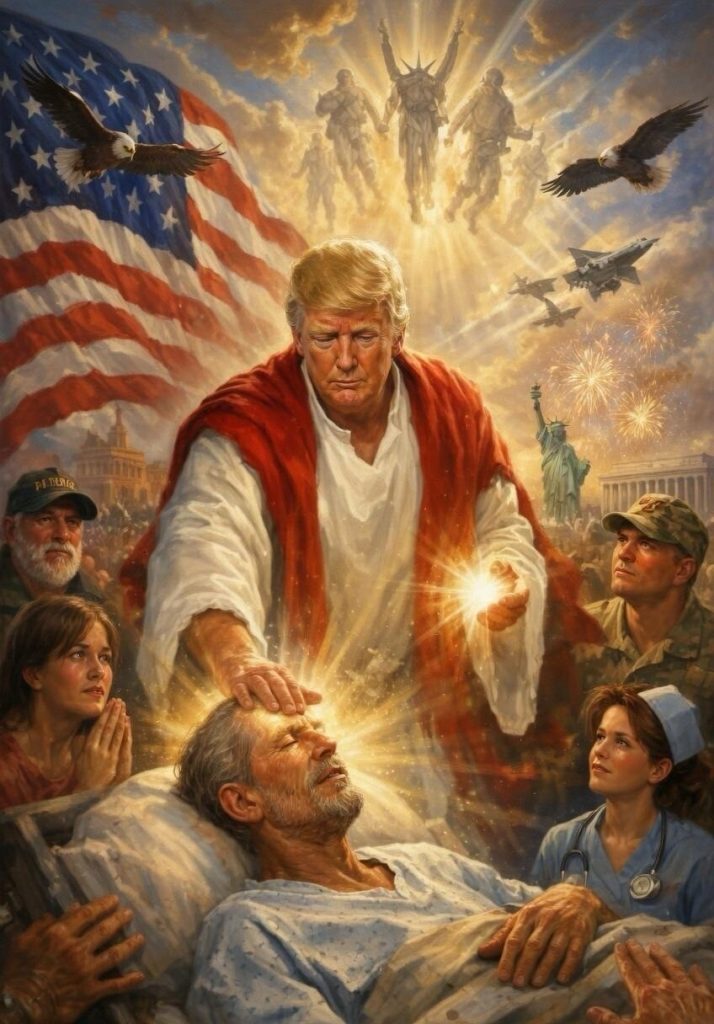
Have you ever wondered what makes President Trump invincible? How he is able to influence so many people? – and the question that haunts me: why does criticizing the President have the opposite effect – i.e. why does it heighten his power?
For my entire adult life I have been accosted by media censuring the now-President. What I find odd – and especially during the now-President’s rise to power in 2015 and 2016 – is why these criticisms were not only ineffectual, but also why they seemed to make the President more popular. The criticisms against the President, and the response by the President seemed to, at least for his base and his voters, strengthen the President’s credibility – or alternatively, diminish the credibility of his critics. What does the President do or say to turn criticism into a metric of strength?
The answer: the President undermines his political opponents by deploying strategies of imitation. Whatever attribute the President’s opposition accuses the President of, the President mirrors thereunto. But the mirroring is sophisticated, cunning, and oftentimes subliminal. So in this article, I am going to analyze the somewhat hostile exchange between Pope Leo XIV and the President from April 7 – 12, 2026, and give a blueprint of the President’s general rhetorical strategy of imitation. With this insight in hand, you, too, can learn how to skirt criticism and generally undermine the common meaning of words!
I. Factual Background
The United States and Israel initiated a military operation against Iran on February 26, 2026, killing, among others, the Ayatollah Khomenei. About a month later, on March 26, 2026, President Trump suspends all military strikes against Iranian infrastructure until April 6, 2026. After a series of deadline extensions, the day before military strikes are to resume, President Trump threatens to destroy Iranian infrastructure: If Iran doesn’t open the strait of Hormuz, they’ll be “living in Hell.” Again, pursuant to a deadline extension, on April 7, 2026, the President threatens to annihilate “an entire civilization.”
And this is where the beef begins.
Later in the evening on April 7, 2026, Pope Leo XIV addresses – though not nominally – the President’s threat against Iran. The Pope calls the President’s threats against Iran “truly unacceptable.” More importantly, the Pope in not so many words calls the President a war criminal. He identifies the President’s threats as violating international law, and that the potential victims of the President’s escalation are innocent. He even asks those listening to snitch on the President: “I would invite everyone to pray but also to seek how to communicate, maybe with the congressmen, with the authorities, to say that ‘we don’t want war, we want peace, we are a people that loves peace.’” The language Pope Leo uses is consistent with language indicting President Trump as a criminal. Whether that criminality is rooted in international or papal law is irrelevant: the point is that there is a non-subjective standard or authority that prescribes a proper mode of behavior, and that the President is violating those laws. All must bend to the concept of morality, including the President of the United States.
On April 11, Pope Leo delivers a similar but not identical message. He proselytizes prayer as a remedy to “the demonic cycle of evil.” In the Kingdom of God, there is no “trivialization of evil,” “no unjust profit,” but only “dignity, understanding and forgiveness.” In the Kingdom of God “we find the bulwark against that delusion of omnipotence that surrounds us and is becoming increasingly unpredictable and aggressive.”
While not addressing the President directly, one need not stretch the imagination to infer the Pope is referring to the President. More specifically, the Pope seems to be condemning the President’s threat of annihilating the Iranian people as leverage in a negotiation. It is no surprise that the President threatened to annihilate an entire civilization at the candle-burning hours of a negotiation. Those threats by the President were said not in earnest, but uttered to gain leverage in a negotiation. The Pope admonishes the President for “trivializing evil” because the President pretends to be unstable, pretends to be morally depraved, in order to gain leverage. The Pope’s sermon on April 11, in short, condemns the President for acting like a tyrant.
II. If You Build It, They Will Come
So , in response to the Pope’s admonitions against the President – viz. that the President is a (moral or international) criminal – what does the President do? He calls the Pope himself – a criminal!! The Pope is a criminal because he condones Iran’s nuclear capabilities. He’s a criminal because he condones Venezuela “emptying their prisons, including murderers, drug dealers, and killers” into the United States. Ostensibly, these “endorsements” by the Pope are criminal because the underlying actions militate against American interests. So, in response to the Pope calling the President an international or moral criminal, the President accuses the Pope of a different kind of criminality: violating the law of “MAGA.”
Unfortunately, “MAGA,” strictly speaking, is not a law: at best, it’s a bundle of shared political interests, or a nebulous principle guiding conduct. It was not a law of MAGA, for example, to invade Iran, since multiple conservative pundits repudiate the invasion as militating against American hegemony. There is no clear description of the conduct “MAGA” or “America First” forbids (or endorses, for that matter). Laws are supposed to clearly describe the conduct the law prohibits; “MAGA” does not do that. It’s just an empty slogan.
“MAGA,” however, functions as a law, insofar as it gives the President the authority to condemn or admonish actions failing to put America first. A duly-appointed judge in the court of law administers the law, and has the authority to sentence a criminal. The Pope, as the corporeal representative of the Kingdom of God, may opine on contemporary events and admonish (or praise) world leaders with Divine authority. The President, similarly, as the progenitor of “MAGA,” has the authority to admonish a person that violates the principles of MAGA. But as we mentioned earlier, “MAGA” is not a law; it’s a means of – candidly speaking – justifying conduct after the fact, since any conduct can be spun as “America First.” In short, the President responds to the Pope’s admonition by imitating the authority of the Pope. Just as the Pope calls the President an international or moral criminal, so too does the President call the Pope a MAGA criminal.
Strategy #1: the President neutralizes his political enemies by erecting a political movement, endowing it with a quasi-juridical aura, and then using the movement’s authority to indict or castigate his political enemies.
III. The Bigger They Are, The Harder They Fall.
So far, we’ve been discussing how MAGA endows the President with the authority similar to the Pope’s. MAGA, essentially, gives the President the credibility to admonish people, including, I suppose, the Pope. But it’s not enough that the President criticizes the Pope ; for the criticism to bite, the President must also discredit the Pope’s aura. The charge of criminality, therefore, also functions to wrest credibility from the Pope.
Nobody believes a criminal. In fact, the American justice system oftentimes excludes evidence of past criminal convictions because its introduction is so prejudicial to the jury. Thus, when the President insinuates the Pope is a MAGA criminal, the President is attempting to diminish the Pope’s credibility, and ultimately his authority as a Divine representative.
The President’s attack against the Pope’s credibility is further buttressed by the next sentence in the vituperative[1]: “[Leo] wasn’t on any list to be Pope, and was only put there by the Church because he was an American, and they thought that would be the best way to deal with President Donald J. Trump.” Pope Leo lacks the authority to criticize the President because Pope Leo was not even a legitimately-elected pope. Notwithstanding the allusions to fraudulent elections, the sentence is more than just a back-handed self-compliment: it delegitimizes the Pope’s authority to put into question the moral uprightness of the President. If the Pope lacks authority, if the Pope himself is engrossed in criminality , the Pope no longer has the credibility to call the President morally bankrupt.
Notice, however, that the President does not deny the President is morally bankrupt. We couldn’t even contemplate the President anxiously scrambling to defend himself against accusations that he is a war criminal, or that he failed to act with American interests at heart. Whatever sort of charges levied against him (by the Pope or whomever), the President goes on the offensive and mirrors the same charge onto the former — albeit in a different form (using Strategy #1.) The President’s response to criticism is a kind of imitation of his opponent’s.
The President’s imitation of criticism, however, is not the same as the original: the simulation, funnily enough, is more powerful than the original and undermines the President’s political enemies. The President’s criminal “indictment” against the Pope is actually more credible than the Pope’s criticism of the President, because, on some unconscious level, Trump admits the criticism is true (or at the very least, is not false.) The truth of the accusations levied against the President legitimizes the President to mirror the exact same charge. Who knows moral bankrupt-ness more than someone who is, too, morally bankrupt ? Who knows more about criminals than a criminal himself? The President’s personal history of corruptness, philandering, and fibbing actually grants him the credibility to call other people generally contemptible.
This is why prosecuting the President for crimes between 2021 and 2024 was such a political blunder by Democrats: Trump doesn’t deny he’s a criminal. It’s his latent criminality that gives him the authority to identify “the swamp,” to lambast “crooked” Hilary, and to decry his 2019 impeachment as a “lynching.” The President’s response to criticism will always be a charming projection of his own moral depravity.
Strategy #2: In response to an attack by one claiming the moral high ground, do not defend yourself. Instead, levy the same kind of charge against that person. The charge of moral contemptuousness gives you credibility to make a counter-charge. Use Strategy #1 to form the content of the counter-charge.
IV. Anything You Can Do I Can Do Better.
In addition to imitating his opponent’s criticism, the President also attacks his opponents personally. While ad hominem attacks are often tacky and unpersuasive, somehow, the President’s ad hominem attacks (especially against Democrats) have fundamentally shifted political discourse and have created the Moby Dick of red herrings. What makes the President’s personal attacks against his political enemies so powerful?
The answer is rooted in psychology. In essence, Democrats have “opened the door” to ad hominem attacks because Democrats embrace Diversity, Equity, and Inclusion. If DEI initiatives can consider a candidates’ subjective, personal history to determine a candidates’ “value,” so too can the President point to his critics’ subjective state of mind to adduce a personal bias. The President’s ad hominem attacks work because they parody the main principle undergirding DEI.
No “Leftie” would deny an individual’s subjective, personal history matters when interpreting speech or writing. Whether an author is black, Asian, trans, a philanderer, had slaves – the demographics and the personal history of our writers – we have been told – color the way we should perceive them. DEI, similarly, asks employers to consider a job applicant’s “objective” skills within the applicant’s socio-politico-historical context. This “Leftist” practice of valuing an individual’s subjectivity ruptures the notion of simple “objectivity.” A job applicant’s skills are no longer objectively said skills: they are mediated by an outside factor beyond individual control.
The President makes a parody of this practice (or value system) by shifting the focus to an individual’s subjective political motivation. In the Post, the President mentions the Pope met with David Axelrod, “a LOSER from the Left.” The political reference to David Axelrod is intended to contextualize the Pope’s criticism. The Pope’s moral condemnation of the President is not sincere because the Pope has a personal, subjective motivation to undermine the President. The Pope cannot be “objective” because the Pope’s criticism is politically motivated to wrest power from the President. And if the Pope is authorized to criticize the President to further the Pope’s personal, political agenda, how can anyone condemn the President when he does the same?! The President’s ad hominem attacks are always justified because all criticism levied against him, when you peel back the curtain, is personal.
To be clear: while DEI considers a candidates’ subjective history, his subjective history is but one factor in the total mix of information. The President, however, changes the rules of engagement: the only factor to evaluate criticism is the critic’s subjective, political agenda at play. Thus, a critic’s entire personal history becomes endowed with a spectral probity related to her secret political motivations. Any act, word, gesture, twitch that can be spun as a symptom of “Trump Derangement Syndrome” becomes significant to the differential diagnosis. The Pope’s visit with David Axelrod – though facially irrelevant to the President’s war crimes against Iran – is circumstantial evidence of the Pope’s furtive political agenda. Personal attacks against the President’s critics transmutes the critic’s entire personal history into circumstantial evidence of his personal animus towards the President. “Trump Derangement Syndrome” is a projection of the manic inquisition into any given critic’s personal animus towards the President.
All criticism by the President is contextualized within the context of the critic’s personal, political motivation behind the critique – independent of whether the motive is factual. The President’s ad hominem attacks level the playing field and make an otherwise earnest critique as hollow as its imitation. The President’s criticism becomes the monster it strives to destroy. “And if you gaze long enough into the abyss, the abyss will gaze back at you.”
Strategy #3: Your opponents’ straying from “objectivity” opens the door to personal attacks against your opponent. All past conduct is probative of your opponents’ personal, political agenda.
V. Conclusion
The President’s rhetoric has created a crisis in meaning. People used to speak, generally, with the underlying, subliminal assumption that their words plainly represent the thoughts inside their mind. When Ms. Clinton during a nationally-televised debate says “it’s awfully good that someone with the temperament of Donald Trump is not in charge of the law in our country,” she’s unsophisticatedly reproducing the thoughts inside her head. The President’s rhetoric , on the other hand, has shifted the paradigm: speech isn’t judged by what it means but how it serves the individual in their quest for power. Everyone is vying for power against one another; when someone speaks, one must ask oneself “what’s in it for them?”
This assumption justifies the President to say or do anything in furtherance thereof. The President can threaten to kill civilians, destroy infrastructure, or praise Allah on Easter, because these speech-acts give him power in a negotiation. Words, lies, and quips are all justified in order to gain power. The inside joke of MAGA is that the President is never telling the truth.
And what’s most despairing is that a speaker’s subjective motives aren’t irrelevant: you’d want to know if your president is self-dealing or didn’t have your interests at heart. – And it is this kernel of truth hidden within the imitation that gives it presence of mind.
We could have prevented the outbreak of this rhetoric if we ignored the President in 2015. If the President accrues more power the more we utter his name, it stands to reason that ignoring him at the outset would have curtailed his influence. But as you can probably guess, ignoring Trump is impossible – especially for his critics. The “Fake News,” though ostensibly opposed to the President, needs the President. Rachel Maddow makes bookoo ratings in her nationally-televised invectives. The media’s profit motive, too, tends to discredit their otherwise “earnest” criticism of the President. Donald Trump is but a natural consequence of the liberal media’s obsession with histrionics and the “trivialization of evil.”
[1] I am aware “vituperative” is an adjective. This is my foray into becoming a Shakespeare impersonator.